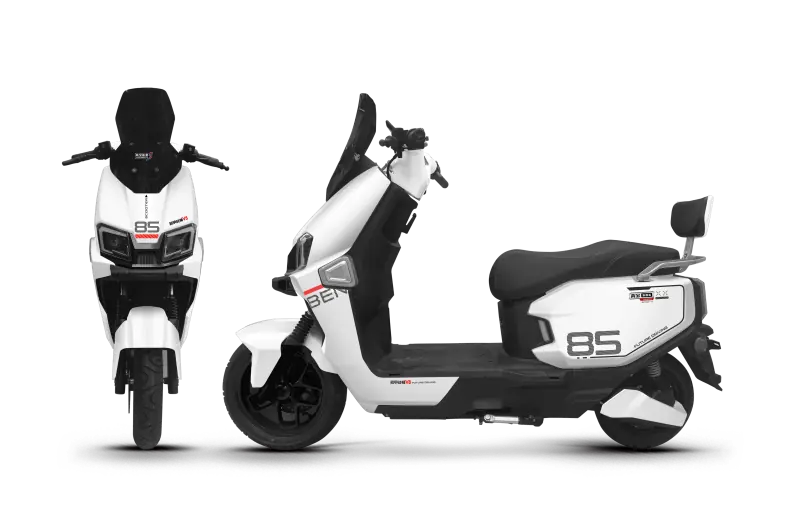
Electric mopeds, scooters and motorcycles can look much the same in a supplier’s catalog. The name alone tells an importer very little about legal classification, performance or import requirements. Start with the destination market and intended use, then check maximum design speed, continuous rated power, battery specification and the local approval route.
A compact scooter-style model may suit short urban trips and a price-sensitive retail offer. Models sold as electric mopeds often cover mainstream commuting, provided their specifications fit local rules. Buyers who need more speed or power will usually be looking at motorcycle-class products. Confirm the legal category with the relevant authority, test laboratory or registration specialist before placing an order.
The short answer: classify first, select the model second
The words scooter, moped and motorcycle are used in two different ways:
- Commercial description: how buyers, dealers and manufacturers describe the vehicle’s appearance, use and market position.
- Legal classification: how a destination country classifies the vehicle for type approval, registration, licensing, insurance, import duty or road use.
A step-through vehicle can have scooter-style bodywork but still be classified as a motorcycle because of its speed or power. A product advertised as a moped in one market may fall into another category elsewhere. Do not select a model from the product name alone.
A sensible buying sequence is:
- Confirm the destination country and intended sales channel.
- Identify the applicable vehicle category and approval requirements.
- Set the required speed, power, range, battery and use case.
- Shortlist models whose actual configurations fit that brief.
- Confirm documentation, samples and compliance before the bulk order.
Electric moped, scooter and motorcycle compared
The table below is a commercial selection guide, not a universal legal definition.
| Term | What it usually communicates to buyers | Typical selection priority | Main importer risk |
|---|---|---|---|
| Electric scooter | Step-through bodywork and an urban, practical design | Size, comfort, storage, range, price and ease of use | Assuming every scooter-style vehicle belongs to a low-speed legal category |
| Electric moped | A two-wheeler marketed for lower-speed use; legal limits vary by market | Local classification limits, commuting range, running cost and target price | Using “moped” as a global legal promise when speed or power limits differ by country |
| Electric motorcycle | A two-wheeler generally positioned for higher speeds and power; styling alone does not determine its legal category | Speed, power, braking, tires, range, chassis and target-rider expectations | Selecting performance before checking approval, registration and licensing requirements |
Classification note: supplier labels are not legal classifications. In the European Union, Regulation (EU) No 168/2013 separates L1e-B two-wheel mopeds from L3e two-wheel motorcycles using criteria that include maximum design speed and continuous rated power. Other markets use different thresholds and tests. Check the current rules where the vehicle will be imported and registered.
Start with the market, not the catalog
“We need an electric scooter” is not a model brief. Climate, roads, terrain, local styling and the vehicle’s daily job all affect the right configuration.
Hills and poor road surfaces
For steep routes, do not choose by motor wattage alone. Review wheel torque, controller current, gearing, loaded climbing performance, thermal protection and braking. Test the intended rider or payload on a representative gradient before approving the configuration.
Larger wheels can roll over potholes and broken surfaces more easily. A 12-inch wheel is a useful point of comparison for rougher roads, but it is not a universal minimum. Tyre profile, suspension, ground clearance, seat height, handling and replacement availability matter as well. BENBAO models such as the V900, RS80 and X900 list 12-inch wheels in their current configurations.
Hot climates and sustained load
High ambient temperature gives the controller and battery less headroom to shed heat, especially on long climbs, under heavy loads or at sustained high speed. Ask about the controller’s continuous current rating, heat sink, installation position, airflow and thermal protection. The battery and BMS operating limits must also suit the market. A short top-speed test does not prove that the system can work reliably on a hot delivery route.
Humid, rainy or coastal markets
For steel frames and brackets, the relevant issue is the complete corrosion-protection system, not “tin plating.” Ask the supplier to document surface preparation, any zinc-based treatment or zinc-coated parts, e-coat or powder-coat layers, coating coverage at welds and cavities, and the treatment of fasteners. Electrical connectors, terminals and cable entries also need suitable sealing and corrosion protection.
If a salt-spray result is supplied, check the test method, specimen, exposure time and acceptance criteria. A salt-spray test compares coated specimens under controlled conditions; it does not predict years of service by itself.
Local styling and accessories
Backrests, rear racks, top boxes, crash bars, colors and body graphics can affect acceptance as much as a specification sheet. Do not assume that one market’s preferred equipment will sell everywhere. If Indonesian dealers, for example, prefer a clean rear-seat design without a backrest, confirm that choice with local samples or dealer feedback before setting the order specification.
For delivery fleets, specify the top box or rear carrier together with the intended load and mounting method. Crash bars may suit markets where buyers want more body protection, but their clearance, attachment points, added weight and packing impact still need review.
Use four filters to build the model shortlist
1. Destination classification
Send the supplier the legal and technical criteria for your market. Confirm registration, licensing, tax, duty and road-use requirements before approving a model.
2. Route, load and local preference
Define road surface, gradients, climate, daily distance, rider or payload and required accessories. Record dealer feedback instead of treating personal taste as market evidence.
3. Complete performance system
Specify maximum design speed, continuous rated power and realistic range. Review battery, controller, brakes, tires, wheels and suspension together rather than comparing one headline number.
4. Commercial and service fit
Check MOQ, production timing, color mix, parts commonality, packaging and local service capability. Confirm which configuration supports each performance claim.
When the standard model is close, define the custom work
A catalog model can be a starting point rather than the final specification. Depending on the platform and order, buyers may request different colors, branding, battery and motor combinations, components or packing. Technical changes can affect range, charging, braking, documentation and cost.
Separate cosmetic changes from technical changes in the RFQ. Ask which requests use an existing option and which require engineering, testing or a revised lead time. For branded or configuration-led projects, see the electric scooter OEM and ODM manufacturing guide. If the vehicle will be assembled locally, the custom SKD kit guide explains how to define the kit, packing and local assembly scope.
A practical BENBAO model-selection matrix
The following examples use current website data and illustrate how to create a shortlist. They are not recommendations for legal classification or road approval.
| Buyer requirement | Models to examine | Current published configuration cues | What still needs confirmation |
|---|---|---|---|
| Compact urban format | Q53a | 1000W, 60V 20Ah, 55 km/h, 55 km range | Destination category, approval route and required battery option |
| Mainstream commuter | G930, G511 | 1200W; up to 55–60 km/h; configuration-dependent range | Target retail price, battery, local terrain and parts plan |
| Retro styling | V900, V910 | 1500W; up to 60–65 km/h; 72V configurations | Market response, color plan, legal category and sample validation |
| Sportier or faster positioning | S902, G721 | 1500–2000W; up to 65–70 km/h | Braking, tires, approval, licence class and intended road use |
| Long-range positioning | RS80, S1200, X900 | Published configurations up to 120 km | Battery type and capacity, test conditions and expected real-world route |
Specifications vary by configuration. The signed specification sheet, approved sample and sales contract should control the order, not a general comparison table.
What to send in a model-selection RFQ
A useful RFQ gives the supplier enough information to recommend a configuration instead of sending the entire catalog.
- Destination country and, where relevant, city or region
- Intended vehicle category or applicable local limits
- Primary use case and expected daily distance
- Target maximum speed and continuous rated power
- Preferred battery type, voltage and capacity
- Required range and the conditions under which it must be achievable
- Rider or passenger requirements and expected payload
- Brake, tyre, suspension and feature preferences
- Target quantity, model mix and color plan
- CBU, SKD or CKD preference
- Required approval and shipping documents
- Target wholesale price range and expected launch date
- Spare-parts and after-sales requirements
It also makes quotations easier to compare because every supplier receives the same brief.
Make the final choice with a sample and written specification
Do not choose a model solely from images, catalog claims or keyword labels. Before a bulk order, use a sample or pre-production unit to check riding position, comfort, braking, controls, charging, assembly quality and the configuration required for your market.
Record the approved motor, controller, battery, charger, brakes, tires, display, lighting, dimensions, color and packaging in a written specification. Also confirm which documents the supplier will provide and which destination approvals remain the importer’s responsibility.
The right model fits the local category, customer use, target price, service capability and launch plan. Extra speed or a longer advertised range has little value if those basics remain unresolved.
Ready to build a shortlist? Compare BENBAO electric vehicle models or send your target market, quantity and required performance for a configuration-based quotation. For questions about samples, payment, documents, warranty and spare parts, visit the Export FAQ.