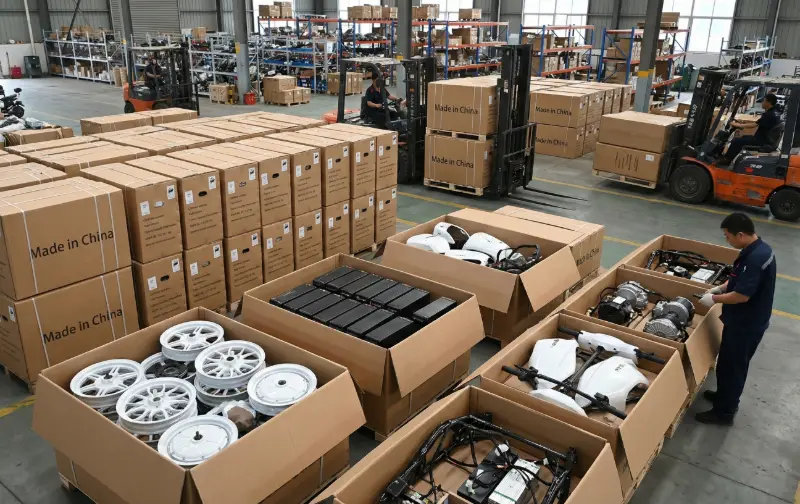
The difference between CKD and SKD electric motorcycle kits is not simply the number of parts in a carton. It decides who performs each assembly step, who controls final quality, what equipment is required locally and who is responsible when the finished vehicle does not meet the agreed standard. The same framework applies to electric moped CKD/SKD kits and selected electric scooter assembly projects.
After reading this guide, you will understand the practical trade-offs between the three supply formats, know what to ask a manufacturer and be able to judge which level of local assembly fits your business.
The abbreviations mean CBU (Completely Built Up), SKD (Semi Knocked Down) and CKD (Completely Knocked Down).
For most buyers, the practical choice is:
- choose CBU when testing a market, launching quickly or operating without a controlled assembly facility;
- choose SKD when a trained local team can complete a limited set of defined assembly steps and final inspection;
- choose CKD only when the buyer has a repeatable production process, trained operators, tools, parts control, traceability and quality gates.
CBU, SKD and CKD compared
The table below summarizes the assembly scope, local workload, best-fit buyer and principal risk for each format.
| Format | What normally arrives | Local work | Best suited to | Main risk |
|---|---|---|---|---|
| CBU — Completely Built Up | A substantially complete vehicle | Receiving inspection and dealer preparation | Market trials, faster launches and buyers without an assembly line | Lower loading efficiency or different duty treatment, depending on market |
| SKD — Semi Knocked Down | Major assemblies plus selected separately packed parts | Defined fitting, adjustment and final inspection | Buyers beginning controlled local assembly | Unclear kit scope and inconsistent workmanship |
| CKD — Completely Knocked Down | More individual parts and subassemblies | Broader assembly, process QC and end-of-line testing | Established assemblers with suitable systems and volume | Missing parts, process variation and traceability failures |
CBU belongs in this comparison because it is the operational baseline. A first CBU shipment may cost more in freight per unit but still be commercially safer than building a new local process before demand is proven. Some buyers can then move from CBU to a defined SKD project and only later to deeper CKD assembly.
The full-cost comparison should include freight and locally confirmed duties, but also assembly labour, supervision, tools, facilities, warehousing, training, rework, local-assembly defects and warranty handling.
Important: CBU, SKD and CKD have generally understood meanings, but there is no single globally applicable parts breakdown or customs treatment. Destination-country customs authorities determine classification, duties and local manufacturing requirements. Confirm the actual kit configuration with a qualified local customs broker or competent authority before ordering.
CKD is not automatically the lowest-cost choice.
Define the kit by parts and responsibilities
The words CBU, SKD and CKD are not enough for a quotation. Ask the manufacturer for:
- a parts and packing breakdown showing every component, subassembly, quantity and package number;
- an assembly responsibility matrix assigning each assembly, adjustment, inspection and test to the manufacturer or local assembler.
The documents should clarify the status of the frame, fork, wheels, brakes, motor, controller, wiring harness, battery, charger, lighting, display, suspension, body panels, accessories, fasteners, labels and spare parts.
The physical split varies by model. A compact moped-style vehicle may not use the same SKD scope as a larger motorcycle-style model because the body panels, battery installation, wiring, brake system and packing geometry differ. Terms such as “moped assembly kit” must therefore be supported by the actual component list.
Match the format to the buyer’s assembly capability
CBU: lowest local process responsibility
CBU is usually appropriate when the market is new, technicians have not been trained, tools and test equipment are not controlled, or local defects would be difficult to diagnose. “Complete” does not always mean that no dealer preparation is required, so the delivered state must still be defined in the contract and packing plan.
SKD: a controlled first step
SKD can suit a buyer able to receive labelled packages, follow illustrated instructions, use specified tools and torque values, inspect steering, brakes and electrical functions, and document final release. The exact steps may include fitting selected model-specific parts, but they must be confirmed rather than assumed.
SKD is not simply CBU with a few parts removed. The packing, protection, assembly interfaces and local inspection plan must be designed together.
CKD: a local production operation
CKD transfers more manufacturing responsibility to the buyer. A suitable operation needs incoming inspection, controlled storage, workstation instructions, trained operators, calibrated tools, in-process quality checks, electrical and chassis tests, traceability, rework control and end-of-line release.
If these systems are not ready, freight or duty savings can be offset by missing parts, inconsistent brake or steering adjustment, electrical faults, rework and higher after-sales cost.
Confirm packing and loading after the scope is agreed
There is no universal CBU, SKD or CKD quantity for a 40HQ container. Capacity depends on vehicle dimensions, model mix, battery arrangement, exact disassembly level, carton or steel-frame design, protection material, stackability and weight distribution.
Upon finalising the configuration and kit scope, BENBAO can provide a model-specific packing and loading plan. Any earlier quantity is an estimate, not a contractual loading figure.
SKD and CKD packing must also preserve part identity and assembly sequence. Review:
- corrosion, moisture and painted-surface protection;
- electrical connector and wiring protection;
- battery packing and handling requirements;
- fastener and small-parts grouping;
- package labels linked to the packing list;
- model, color and batch identification;
- receiving and assembly sequence;
- container securing and movement prevention.
Before shipment, reconcile the agreed parts list, packing list, package labels and actual loaded packages.
Send a quote request for a defined kit
Use the same RFQ basis when comparing suppliers. Include:
- target country and destination port;
- buyer type and expected annual volume;
- model, battery, motor and exact configuration;
- sample or trial quantity and expected first container quantity;
- preferred CBU, SKD or CKD format, or a request for a recommendation;
- local assembly facility, capability and intended local operations;
- required parts list, packing breakdown and inspection documents;
- required instructions or training;
- branding, labels and packaging requirements;
- preferred Incoterm with named place or port;
- target launch date.
The quotation should identify the pre-assembled modules, separate parts, battery arrangement, package count and dimensions, estimated loading assumptions, tools and documents included, approval milestones, Incoterm, validity and exclusions.
BENBAO’s normal production MOQ is 30 units per model. Final order planning is confirmed according to the selected model, configuration and packing plan. Colors from the standard palette have no separate color MOQ within an eligible model order. A custom color outside our standard palette normally requires 30 units in that color. Mixed-model loading can be discussed.
Build quality control into local assembly
Factory inspection does not replace the local assembler’s controls. A practical local quality plan should cover:
- incoming package, damage, identity and quantity checks;
- correct parts, routing, adjustments and specified torque during assembly;
- charging, lighting, switches, display and electrical-function checks;
- steering, brakes, tires, wheels, suspension and critical fasteners;
- final function, appearance, labels, accessories and release records;
- traceability between the finished vehicle, kit batch and inspection result.
Our factory-side quality workflow covers incoming, in-process, patrol and final-unit inspection. The project agreement defines which inspection records we supply and which checks remain the local assembler’s responsibility.
Depending on the confirmed model and project, supporting materials may include specifications, exploded views, parts lists, packing breakdowns, work instructions, wiring information, torque requirements, inspection checklists, troubleshooting information and battery transport documents. Availability, language, revision and delivery format must be agreed before the order.
Make the final decision
Move to a deeper assembly format only when:
- customs and local-manufacturing treatment have been checked independently;
- the kit breakdown and responsibility matrix are written down;
- operators, supervisors, tools and test equipment are ready;
- receiving, storage and traceability can be controlled;
- work instructions and inspection criteria are understood;
- battery handling and transport documents are confirmed;
- defects can be diagnosed and reworked locally;
- total assembled cost has been compared with CBU;
- a trial build will be approved before volume production.
If several conditions are not ready, begin with CBU or an SKD format requiring fewer local assembly steps.
For bulk assembly-project orders, our standard spare-parts allowance is 1% of the FOB contract goods value, subject to project agreement. The selection should consider both after-sales parts and likely assembly-loss items. Warranty and responsibility for local assembly must be defined in the project contract.
Discuss your assembly project with BENBAO
Share the target country, model, expected volume, preferred CBU/SKD/CKD format, local facility, available technicians, required documents and destination port. BENBAO can then discuss a model-specific kit scope, packing plan and quotation.
Ready to discuss your assembly project? Share your target market, expected volume and preferred assembly format with our export team.
Request a quotation · Browse BENBAO electric motorcycle models · Export FAQ