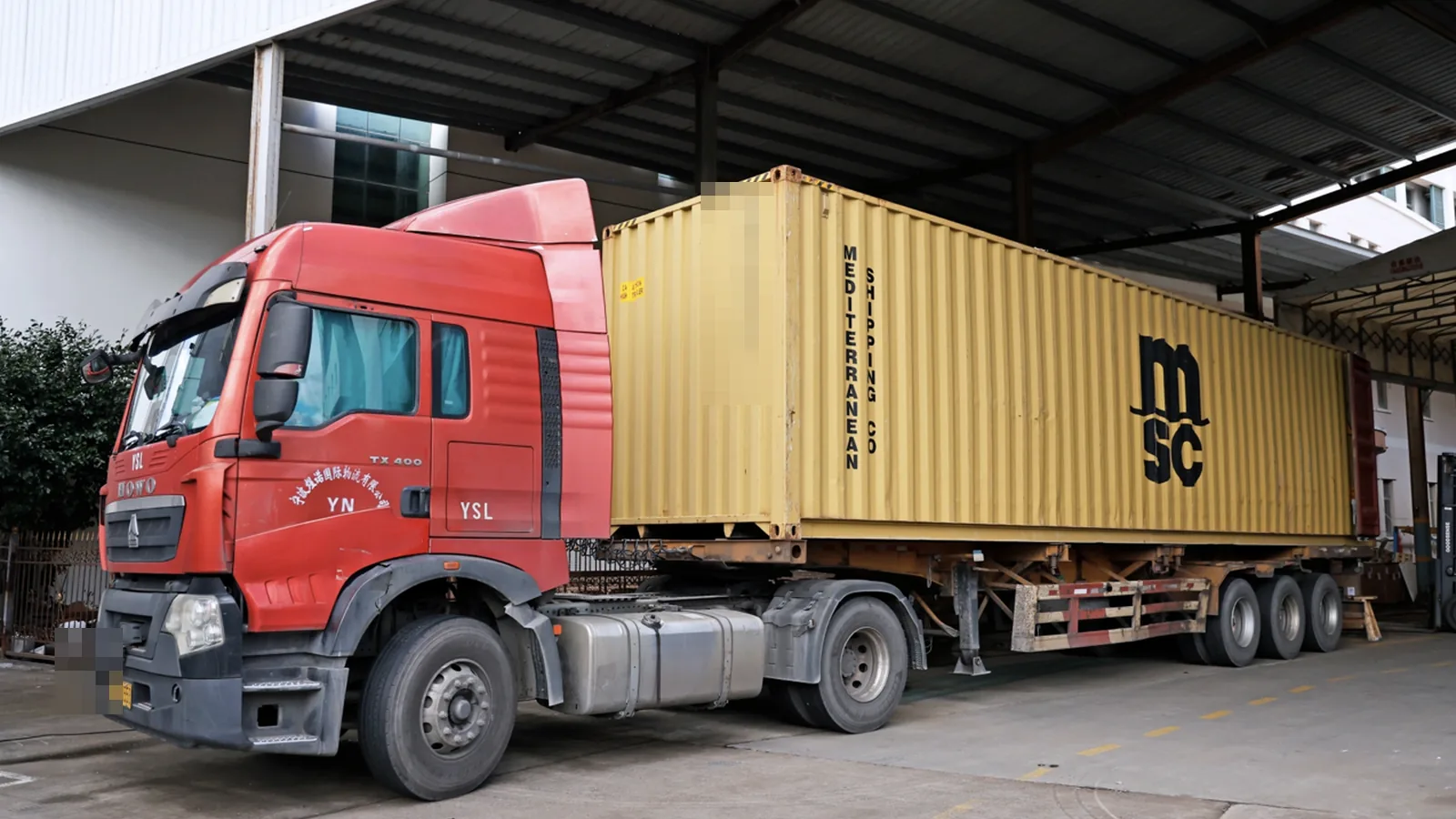
The shipping documents for an electric motorcycle order depend on four decisions: the destination country, vehicle configuration, battery type and packing method, and agreed Incoterm. Settle these details before quotation and check them again before booking. A document list copied from a previous shipment may not suit a different model, battery or route.
For a typical BENBAO export order, the buyer should expect a commercial invoice, packing list and bill of lading, together with any origin, battery-transport or destination-market documents confirmed for that shipment. The invoice and packing-list drafts are reviewed before loading. Final shipment data are checked after loading, and the bill of lading is issued after sailing.
The buyer, BENBAO and the freight forwarder must agree on the document scope. BENBAO supplies the vehicle, battery, packing and commercial information. The forwarder handles booking and the dangerous-goods declaration for the shipment it carries. The importer remains responsible for confirming destination-country clearance, registration and approval requirements.
Confirm the shipment before requesting the document list
Provide the following information at the quotation stage:
- destination country and destination port;
- vehicle model, configuration and quantity;
- lithium-ion or lead-acid battery specification;
- whether the battery will be installed in the vehicle or packed separately;
- CBU, SKD or CKD supply format;
- number and type of containers;
- FOB, EXW or another agreed Incoterm;
- certificate of origin, chamber certification or other destination-specific requirements;
- consignee and notify-party details, if already available.
Battery packing should not be left until the loading date. BENBAO normally confirms whether lithium batteries will be installed or removed before quoting because that decision affects packing, container planning, dangerous-goods classification and pre-carriage costs.
BENBAO most often ships through Ningbo. Shanghai is also used, while some simpler vehicle orders may ship through Tianjin. The final port depends on the cargo, sailing schedule, forwarder and quotation.
The core commercial and transport documents
The exact set varies, but most container orders use the following documents.
| Document | Main purpose | When BENBAO normally confirms it |
|---|---|---|
| Proforma invoice or sales contract | Confirms the model, specification, quantity, price, Incoterm and payment terms | Before the order is placed |
| Commercial invoice | States the goods and transaction information used for shipment and import | Draft checked before loading; final version based on the shipment |
| Packing list | Records packages, quantities, weights, dimensions or volume, as applicable | Draft checked before loading; final figures checked after loading |
| Bill of lading | Carrier’s transport document for the sea shipment | Draft checked before release; issued after sailing |
| Certificate of origin | Supports origin declaration or a relevant trade arrangement when applicable | Requirement and type confirmed before quotation |
| Battery and dangerous-goods documents | Support classification, booking, declaration and carrier review | Confirmed for the battery, packing method, route and carrier before booking |
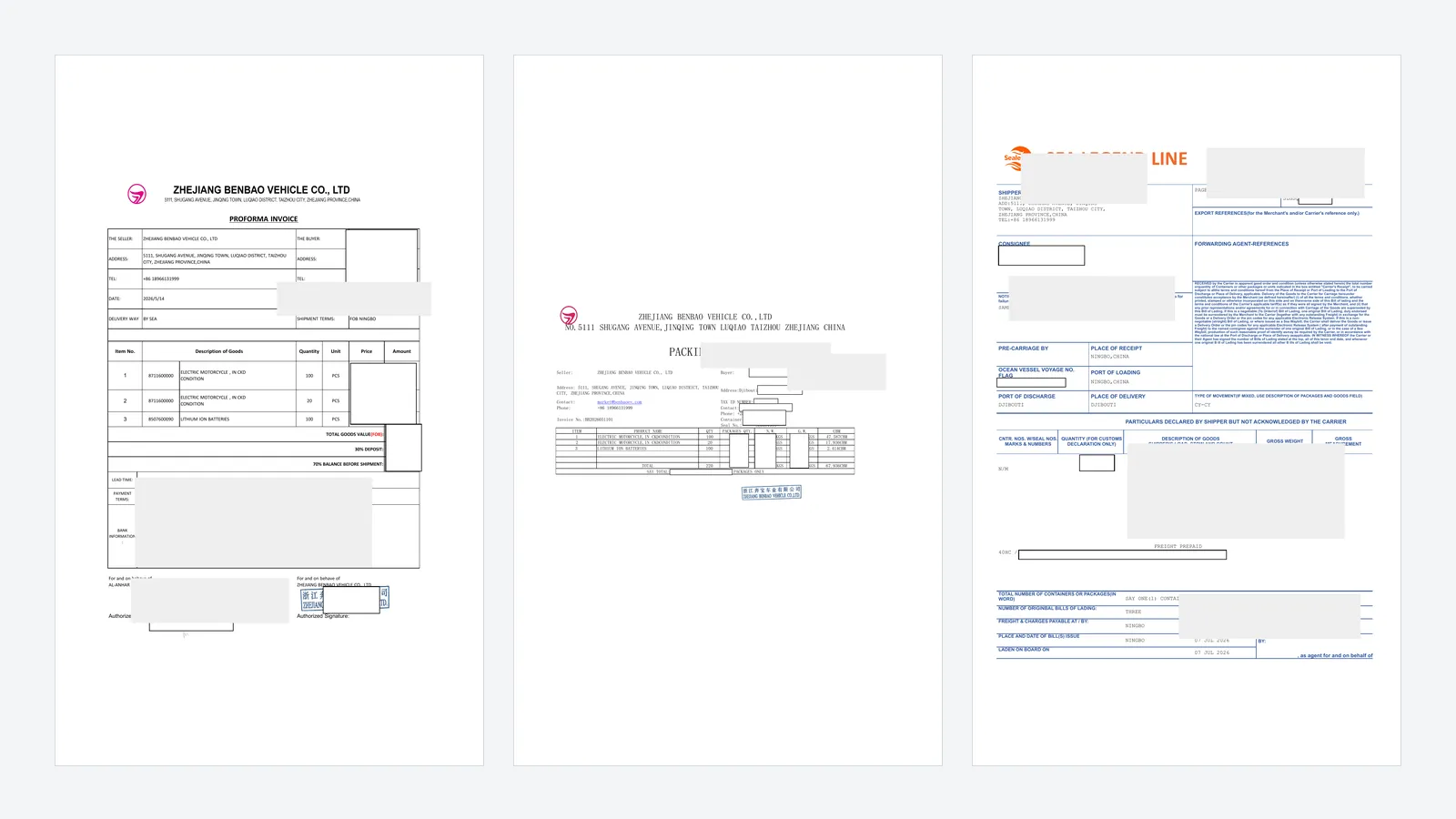
Redacted document examples from completed BENBAO export work. Each shipment is prepared against its own order, route and customer instructions.
BENBAO normally sends the commercial-invoice, packing-list and bill-of-lading drafts to the customer for written confirmation by email or business chat. Check the company name and address, consignee, notify party, goods description, models, quantities, package count, weights, ports and battery packing status rather than approving the files by title alone.
Telex release is used for most BENBAO shipments. Original bills of lading can also be arranged when requested. The release method must be agreed in time to avoid delaying document delivery. The bill of lading is provided after sailing and receipt of the required payment, before the cargo reaches the destination port.
Lithium-battery packing changes the declaration
About 70% of BENBAO’s lithium-battery vehicle shipments leave with the battery installed in the vehicle. This is often more space-efficient because the battery does not require a separate position in the container. BENBAO can also remove and pack the battery separately when the buyer, packing plan or transport route requires it.
The two arrangements are not interchangeable on the paperwork. Under the current IMDG Code, a vehicle powered only by a lithium-ion battery may be assigned to UN 3556 — VEHICLE, LITHIUM ION BATTERY POWERED. A battery removed from the vehicle may instead fall under UN 3480 — LITHIUM ION BATTERIES or, where the actual packing arrangement qualifies, UN 3481 — LITHIUM ION BATTERIES PACKED WITH EQUIPMENT. The correct entry cannot be selected from the sales description alone. The forwarder or dangerous-goods declarant must confirm it against the battery, vehicle, packing method and current carrier requirements.
Do not ask the supplier to change only the wording after the packing method changes. The booking, declaration, marks, labels and supporting files may also need revision.
Damaged, swollen, leaking or otherwise abnormal batteries must be isolated and kept out of the normal export shipment. They should not be included merely because the document set has already been prepared.
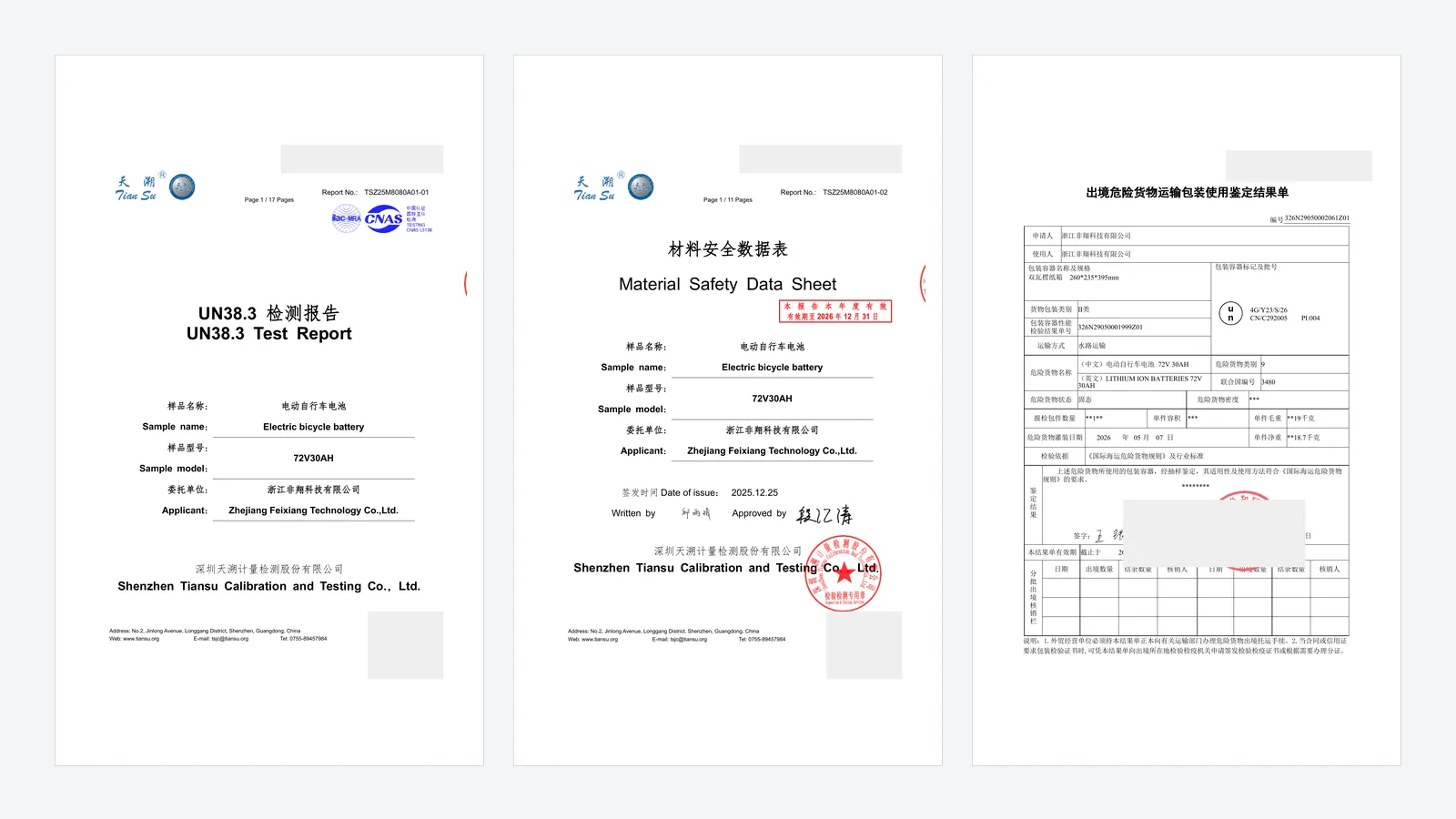
Typical battery-supporting records include a UN 38.3 test report, a safety data sheet and the packaging document required for the actual shipment. Availability and acceptance must be checked for the selected battery and route.
Lead-acid battery orders need a packing decision too
BENBAO usually exports lead-acid vehicle orders with batteries included, although buyers may source batteries locally. The batteries are normally removed from the vehicle for packing. They can also be installed when the model and shipping plan permit.
Weight is the main packing concern. When lead-acid batteries remain installed, BENBAO recommends a steel-frame packing solution or, at minimum, a stronger reinforced corrugated carton with protective wrapping. The final method must match the vehicle, battery weight and loading plan. The forwarder should still confirm any transport classification and carrier requirements for the selected battery and route.
Consolidating batteries in one container
For many CKD or SKD projects, lithium batteries travel in the same container as the vehicle parts, and that container is booked as dangerous goods. A buyer may also separate the batteries from the other parts.
For example, in a three-container order, the batteries may be consolidated into one dangerous-goods container while the two containers carrying no lithium batteries move as general cargo. This can reduce the total dangerous-goods transport cost, but it is not a standard saving that applies to every project. Battery quantity, matching vehicle or frame numbers, package count, weight distribution, container capacity, port rules and carrier acceptance must all be checked first.
The packing split must remain traceable. For CKD and SKD projects, BENBAO can provide frame and parts-number lists, component information, work instructions, assembly videos and a wear-parts list according to the agreed project scope.
Who handles the dangerous-goods booking?
For an FOB order, the buyer may use a BENBAO partner forwarder or nominate its own. The freight forwarder arranging the shipment is responsible for the booking, dangerous-goods declaration and submission of the required transport documents. BENBAO supplies the corresponding vehicle, battery, packing and supporting information and works with the forwarder to resolve questions.
Carrier acceptance is not guaranteed simply because a supplier has provided a previous report. Requirements can change with the shipping line, vessel, port, route, battery and packing method.
BENBAO normally contacts the forwarder about a week before the order is expected to be ready to review available sailings and dangerous-goods space. Some buyers postpone booking while waiting for a lower ocean-freight rate. That may delay dispatch or require document dates and schedules to be updated. Production completion does not reserve vessel space.
What the FOB price includes—and excludes
Once the battery arrangement, packaging, port, route and booking conditions have been agreed, BENBAO normally includes the pre-departure dangerous-goods surcharge, declaration and related local handling costs in its FOB quotation.
If the buyer changes the battery arrangement, container type, nominated forwarder, port or route after quotation, the local costs must be recalculated. A quoted FOB amount should not be treated as covering every later change.
BENBAO’s FOB price does not include:
- international ocean freight;
- cargo insurance;
- destination-terminal and port charges;
- import duty or tax;
- destination customs clearance;
- inland delivery after arrival.
This distinction matters when comparing FOB with EXW, CIF or DDP. Use the wholesale electric scooter MOQ, FOB and lead-time guide to compare the commercial terms on the same basis.
Confirm certificates before the quotation
Certificates of origin and destination-specific commercial documents are not automatic additions to every shipment. Identify them before quotation so the issuing route, processing time and cost can be checked.
BENBAO has arranged certificates of origin for orders to the Philippines, other Southeast Asian markets and Ukraine. For the Philippines, this has included the China–ASEAN Certificate of Origin, Form E. Eligibility for Form E and any preferential tariff treatment still depends on product classification, origin rules, destination requirements and the authorities reviewing the import.
In one BENBAO shipment to Ethiopia, the importer first requested an Electronic Cargo Tracking Note (ECTN) and later asked for additional commercial documents certified through the China Council for the Promotion of International Trade (CCPIT). These were separate requirements, not two names for the same document. This project experience should not be treated as a permanent rule for every Ethiopian shipment. The importer and its clearance agent must provide the current requirement and exact document to be certified before quotation.
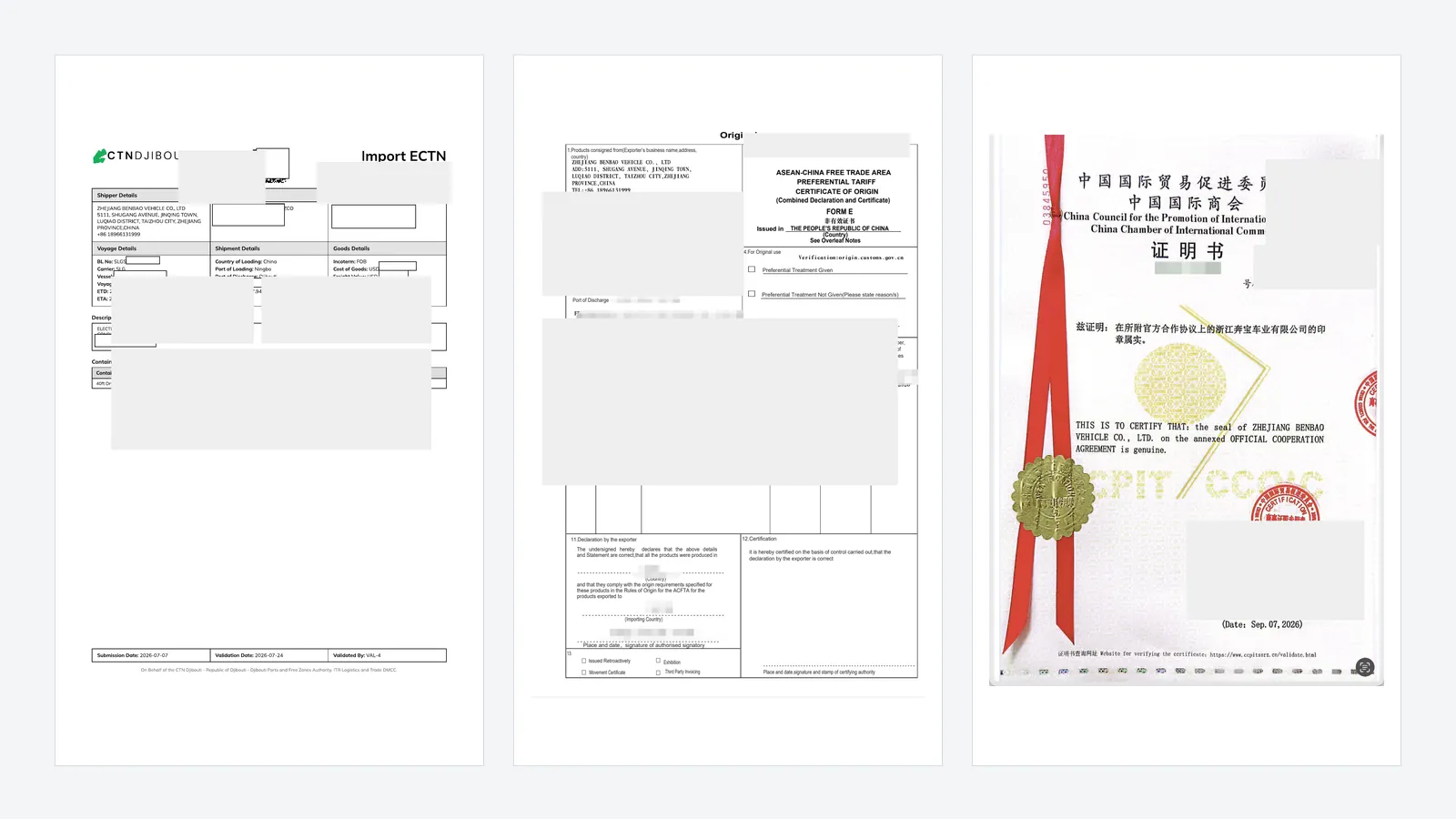
Destination-specific examples: ECTN, China–ASEAN Form E and CCPIT certification serve different purposes and are arranged only when the current shipment requires them.
For an FOB order, BENBAO includes the cost of certificates identified and agreed before quotation in the FOB price. A certificate requested after quotation or order confirmation is charged separately. Under EXW, certificate processing is outside the goods price and is quoted separately if the buyer asks BENBAO to arrange it.
Product approval documents are a separate responsibility
Shipping documents allow the cargo to move; they do not by themselves approve the vehicle for sale or registration in the destination country.
Depending on the model and project, BENBAO can provide technical specifications, nameplate information, VIN or frame-number lists, exploded views, configuration information, work instructions and available certification records. CKD and SKD projects can also include parts-number information and agreed assembly material.
These files can support an importer’s application, but the importer should confirm the approval route with its customs broker, registration authority or qualified local adviser before the production specification is agreed. A change to the motor, battery, lighting, brakes, dimensions or structure may affect whether an earlier report remains applicable.
Review the drafts before loading and release
Document control works best as a sequence:
- Before quotation: confirm the destination, Incoterm, battery packing and requested certificates.
- Before booking: give the forwarder the final vehicle, battery, packing and container plan.
- Before loading: review the commercial-invoice and packing-list drafts and any customer-specific wording.
- After loading: reconcile actual quantities, package count, weights, container number and seal number.
- Before sailing or document cut-off: approve the available final data and bill-of-lading instructions.
- After sailing: review the bill-of-lading issue or release and retain the final document set.
After loading, BENBAO can provide loading photographs, container and seal numbers, loaded quantities, the bill-of-lading draft and sailing information. The timing of each file depends on the forwarder and carrier.
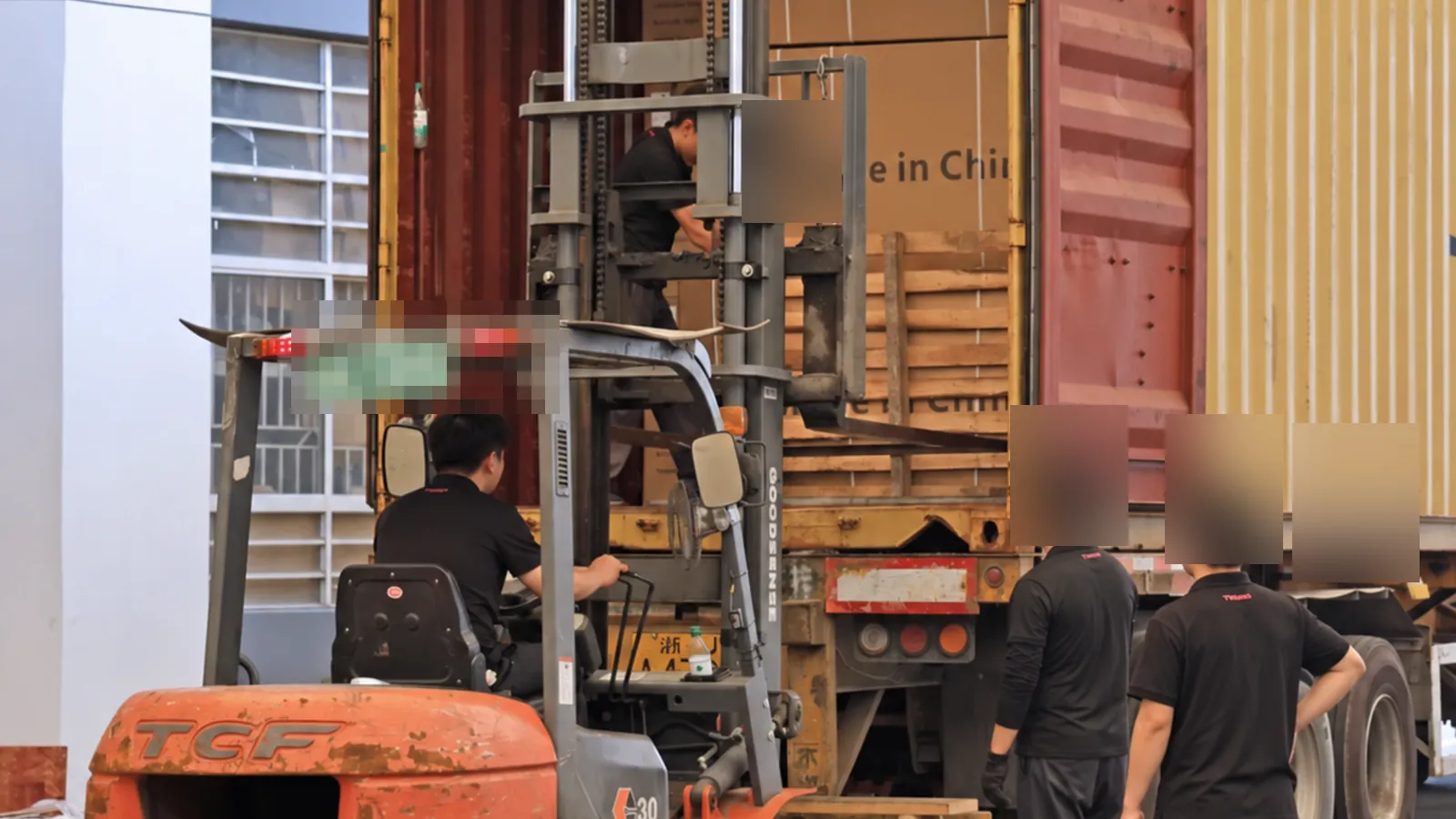
Loading records help reconcile the physical shipment with the packing list, container number, seal number and final bill-of-lading instructions.
If the buyer requests a change after providing written approval, any amendment, storage, detention or related charge caused by that change is normally for the buyer’s account. If the issue arose from BENBAO, from information neither party identified earlier, or from several causes, responsibility and cost are reviewed case by case. The safest approach is to settle destination wording and battery status before the carrier’s document cut-off.
Pre-shipment document checklist
Before approving shipment, check that:
- the buyer’s legal name, address, consignee and notify-party details are correct;
- the model and goods description match the signed specification;
- quantity, package count, net weight and gross weight agree across documents;
- the battery chemistry, model and packing status match the physical shipment;
- CBU, SKD or CKD descriptions match the actual component state;
- container and seal numbers match the loading record;
- the dangerous-goods entry has been confirmed by the responsible forwarder;
- the required certificate of origin or commercial certification was identified before quotation;
- destination approval documents are not being confused with shipping documents;
- the bill-of-lading wording and release method have written customer approval;
- any post-loading change has been communicated to every party using the affected data.
For the complete sourcing sequence, read the electric motorcycle import guide. If the order will be supplied for local assembly, define the component and packing responsibilities in the CBU, SKD and CKD buyer’s guide.
Ready to prepare a shipment-specific document list? Send BENBAO your destination country, vehicle model, battery type, quantity, CBU/SKD/CKD format and preferred Incoterm for a document review and quotation. For shorter questions about samples, payment, warranty and export support, visit the Export FAQ.